EINION AP CELYNIN OF LLWYDIARTH
By Darrell Wolcott
The ancestor of the Lloyd family
of Dolobran and the now-extinct Vaughan family of Llwydiarth Hall in Mechain, Einion ap Celynin has a pedigree which traces
back to Aleth of Dyfed. However, many of the claims made concerning the 13th century Celynin and his settlement in Powys
are probably false. The Welsh Herald, Lewys Dwnn, says this Celynin "killed the Mayor of Carmarthen" [1] and other writers
added "and fled into Montgomeryshire" [2] probably on no more evidence than the fact that his son Einion lived at Llwydiarth.
While earlier generations of this
family probably did live in Ystrad Tywy (modern Carmarthenshire), a look at the marriages made by the father and grandfather
of Celynin indicates they may have relocated to south Powys (Powys Gwenwynwyn) before Celynin was born. Celynin was living in 1292[3] and his son Einion occurs in 1340[4], so the Aleth from which they descended
was born c. 1085 and was not the same man as "Aleth, king of Dyfed".[5] The early citations agree with this chart [6]:
1085 Aleth
l
1115 Uchdryd
l
1150 Gwrgeneu
l
1180 Iorwerth
l
1210 Cynddelw
l
1240 Rhiryd
l
1270 Celynin
l
1300 Einion
We suggest the earlier generations
back to Aleth ap Bledri (who was merely brother to Hyfaidd ap Bledri, king of Dyfed) were:
820 Rhodri Mawr Aleth 840
l
l
865 Tudwal Gloff====Elen 875
l
895 Alser
l
930 Aelan (or Alyn or Aelaw)
l
960
Llawr
l
990 Aleth
l
1020 Uchdyrd
l
1055 Gwrgeneu
l
1085 Aleth
(continuing as the first chart)
We can date the generations
which immediately followed Einion ap Celynin from a 1419 document in which Edward de Charlton, Lord of Powys, granted a pardon
to Gruffudd ap Jenkin ap Llewelyn ap Einion ap Celynin. In that document[7], family lands once held by the grandfather
of Gruffudd (Llewelyn ap Einion ap Celynin) at Llwydiarth and elsewhere in upper and lower Mechain were confirmed to Gruffudd.
Some historians assume the crimes for which Gruffudd ap Jenkin was pardoned involved his participation in the Owain Glendwr
rebellion, but this Gruffudd would have barely been a teenager in the Glendwr era. More likely, he had been among the
roving outlaws of the early 1400's which had included other young men of Powys.[8] In 1419, his grandfather Llewelyn
was dead but was survived by his wife (Gruffudd's grandmother) "Lleucu filia Gruffuth ap Eden Loid". The document does
not say if Jenkin ap Llewelyn was still alive, but that man would have been the right age to have joined the Glendwr rebellion
and it may have been his lands which had been confiscated and were now being confirmed to his son. To extend our
pedigree chart 3 more generations, we find:
1270
Celynin Ednyfed Llwyd
l
l
1300
Einion Gruffudd
Madog Cyffin 1300
l
l
l
1330 Llewelyn=====Lleuci (a) Ieuan Gethyn
1335
l
l
1360 Jenkin(b)========Gwenhwyfar 1370
l
1390 Gruffudd(c)
(a) The further ancestry
of this lady, born c. 1345, is unknown. There is another Llewelyn ap Einion in this extended family who was born
c. 1360. Dwnn i, 294 and Dwnn ii, 277 cite his marriage to a Lleuci ferch Ednyfed Llwyd ap Gruffudd ap Ieuan ap
Iorwerth Goch descended from Tudor Trefor, a lady born c. 1370. While the citation Lleuci has an ancestry
amazingly similar to the Lleuci in our chart, the chart Lleuci's father is named in a document written in her lifetime
and is unlikely to be wrong
(b) Dwnn i, 294 and Dwnn ii,
277 cite this marriage which does fit chronologically. Madog Cyffin occurs 6 generations after Madog ap Maredudd ap Bleddyn
ap Cynfyn(born c. 1095), being descended from Madog's base son Einion Efell.
(c) Dwnn i, 294 says he married
Mallt ferch Hywel Sele ap Meurig, a lady born c. 1410 of the Nannau family, again confirming that Gruffudd was a generation
too young to have been in the Glendwr rebellion. Hywel Sele was killed by Owain Glendwr when Hywel tried to assassinate
him during a hunting trip together; Owain had thought Hywel an ally and didn't know he was loyal to King Henry IV.
Now that we have closely dated
Einion ap Celynin of Llwydiarth to c. 1300, we must account for a second citation found in Dwnn ii, 277. The first pedigree
on that page concerns a family descended from Rhys ap Llowdden living at Plas Cammeirch in the Parish of Llanfachreth,
Meirionydd. (Nannau was also in this parish) The third pedigree on the page is headed "Plwyv Eto" or "the same
parish a second time". There we find a "Celynin ap Rhiryd ap Cynddelw ap Iorwerth ap Gwrgeneu ap Uchdryd ap Aleth".
This man is said to have married "Gwladys daughter and heiress of Rhiryd ap Cynwrig Efell". Dwnn continues by saying
"from whom he obtained Llwydiarth", but he obviously has confused this Merionydd family with the Celynin ap Rhiryd of Llwydiarth
in Mechain, Powys. That there were at least two branches of the family descended from Aleth who repeated a long
string of male names can be seen from Dwnn's next statement. He says the mother of this Gwladys was Arddun ferch Ithel
Goch ap Dafydd ap Maredudd ap Bleddyn. Charting this Meirionydd family shows these approximate birth dates:
990 Aleth
l Bleddyn
1025
1020 Uchdryd
l
l Maredudd 1065
1055 Gwrgeneu ______l___________
l l
l
1085 Iorwerth(a) Madog 1098 Dafydd
1102
l l
l
1120 Cynddelw Cynwrig Efell 1135 Ithel Goch 1140
l l
l
1150 Rhiryd 1165 Rhiryd========Arddun 1175
l
l
1180 Celynin=========Gwladys 1195
(a) It was a brother
of this man, Aleth, who repeated the male naming sequence leading to the c. 1270 Celynin ap Rhiryd. That family is shown
on the first chart displayed in this paper.
There were two other wives cited
for a Celynin ap Rhiryd which appear to belong to this c. 1180 Celynin. Dwnn i, 307 says a wife of Celynin was Alswn
ferch Cynfelyn ap Dolphyn. Dwnn i, 294 says a Celynin ap Rhiryd married Gwenllian ferch Maredudd ap Rhydderch.
The latter citation continues its Rhydderch as "ap Tewdwr Mawr" but we suggest the correct ancestry was "Maredudd ap Rhydderch
ap Maredudd Fras ap Rhydderch ap Tewdwr". The full ancestry of the cited Alswn was "Cynfelyn ap Dolphyn ap Rhiwallon"
with this Rhiwallon being a brother of Bleddyn who was father to Cadwgan of Nannau. These two wives can be charted as:
1023 Tewdwr
l
1045 Madog 1055 Gwrgeneu
1053 Rhydderch
l
l
l
1075 Rhiwallon 1085 Iorwerth
1080 Maredudd Fras
l
l
l
1110
Dolphyn 1120 Cynddelw
1115 Rhydderch
l
l
l
1140 Cynfelyn 1150 Rhiryd . 1145
Maredudd
l
l
l
1180
Alswn===========Celynin=============Gwenllian 1185
l 1180
1220 Arddun
Dwnn ii, 277 cites 6 children for its Celynin, by wife Gwladys ferch Rhiryd, these being Madog, Einion, Rhiryd, Iorwerth Dwy,
Arddun and Gwladys Fychan. However, in the next pedigree of the same page, Dwnn says the children of Celynin by Gwenllian
ferch Maredudd were Einion, Madog and Rhiryd. There is no Einion ap Celynin found anywhere in the extant pedigree manuscripts,
who could be born earlier than c. 1270. There are no families anywhere cited for children of Celynin named Madog, Rhiryd
or Iorwerth Dwy, so they might belong to a later Celynin ap Rhiryd. The only child known to fit with this c. 1180 Celynin
is Arddun, born c. 1220, who married Madog ap Hywel ap Gruffudd ap Gronwy ap Gwrgeneu ap Hoedliw ap Cadwgan ap Elystan
Glodrydd, and that Madog was born c. 1210. [9] Gwladys Fychan might be a daughter of this Celynin, by his wife
Gwladys, but nothing is known of her.
Having now located a cousin line of our c. 1300 Einion ap Celynin of Llwydiarth, which had earlier used the name-string "Celynin
ap Rhiryd ap Cynddelw ap Iorwerth ap Gwrgeneu ap Uchdryd ap Aleth", we should consider whether there are yet other cousin
lines which used that same name-string. In fact, we found two more such lines, each which had a Celynin who named a
son Einion. We present here a chart of all 4 families:
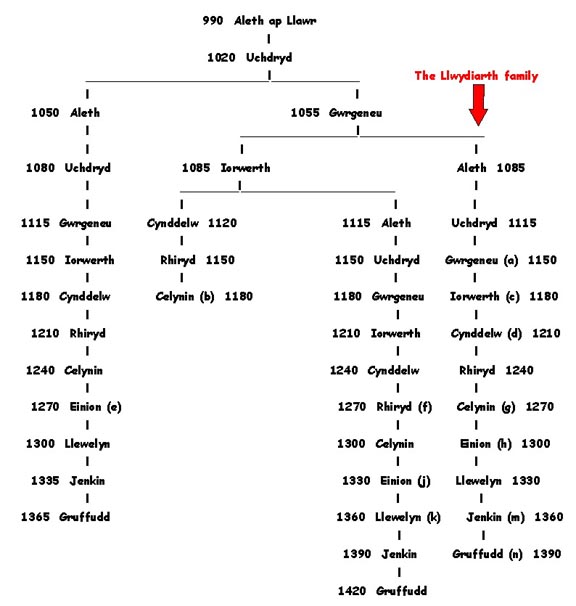
All of the four cousin branches shown in our chart include an identical 7-name string of men named
"Celynin ap Rhiryd ap Cynddelw ap Iorwerth ap Gwrgeneu ap Uchdryd ap Aleth". Three of those families extend this for
4 more generations with a "Gruffudd ap Jenkin ap Llewelyn ap Einion" following their "Celynin". An analysis of the marriages
cited for these men suggests each of these families resided in the Dyfed/Ystrad Tywy area down to the men born near 1270,
and they appear to have relocated to Powys thereafter.
(a) Dwnn i, 294 cites the marriage of Gwrgeneu ap Uchdryd to Alis (1165)
ferch Gronwy (1130) ap Einion (1095) ap Llywarch (1065) ap Gronwy (1035) ap Einion (1005) ap Llywarch of Is Cennin, descended
from Ynyr ap Pasgen of Gower.
(b) This Celynin had 3 wives, as discussed earlier in this paper.
(c) Dwnn i, 294 cites the marriage of Iorwerth ap Gwrgeneu to Efa (1195)
ferch Aaron (1160) ap Rhys (1140) ap Bledri Latimer (1095) ap Bledri (1065) ap Cadifor Fawr of Dyfed.
(d) Dwnn i, 294 cites the marriage of Cynddelw ap Iorwerth to Sian (1215)
ferch Gwrwared (1180) ap Gwilym (1145) ap Gwrwared (1110) ap Cuhelyn Fardd (1077) ap Gwynfardd Dyfed (1050) descended
from Tudwal Gloff of Dyfed.
(e) All the marriage matches we assign the descendants of this Einion were
with spouses in or near Powys, and all require their ancestor, Einion ap Celynin, to be a man born c. 1270. See Appendix
II
(f) Dwnn i, 294 cites the marriage of Rhiryd ap Cynddelw to Gwladys (1285)
ferch Richard, Lord of Dinas Certhin (1250). We identify this Richard as a son of Madog of Mawddwy (1215) ap Gwenwynwyn
Cyfeiliog (1183). This Rhiryd ap Cynddelw appears to be the first man in his branch of the family to relocate to Powys.
(g) Pen 177, 36 cites the wife of this Celynin ap Rhiryd as Gwenllian (1275)
ferch Adda of Mochnant (1240) ap Meurig (1210) ap Pasgen III (1180) ap Gwyn III (1150) ap Gruffudd III (1115) of the First
Powys Royal Dynasty.
(h) Pen 128, 808b, 822b & 847a, together with Pen 135, 383, cite "the
mother of Llewelyn ap Einion ap Celynin" as Gwenllian (1310) ap Adda (1275) ap Meurig (1245) ap Cynwrig (1210) ap Pasgen III
(1180) of the First Powys Royal Dynasty. She was the 2nd cousin (once removed) of the Gwenllian mentioned next above.
(j) All the marriage matches we assign the descendants of this Einion were
with spouses in or near Powys, and all require their ancestor, Einion ap Celynin, to be a man born c. 1330. See Appendix
III
(k) Dwnn i, 294 and Dwnn ii, 277 cite the marriage of Llewelyn ap Einion
to Lleuci (1370) ferch Ednyfed Llwyd (1340) ap Gruffudd (1310) ap Ieuan (1280) ap Iorwerth Goch (1250) descended from
Ednyfed of Broughton ap Cynwrig ap Rhiwallon of the family of Tudor Trefor. However, see Appendix IV for comparison with another
Lleuci who supposedly married a man named Llewelyn ap Einion ap Celynin.
(m) Pen 128, 807b cites the marriage of Jenkin ap Llewelyn to Gwenhwyfar
(1370) ferch Ieuan Gethin (1335) ap Madog Cyffin (1300) descended from Einion Efell, a base son of Madog ap Maredudd ap Bleddyn
ap Cynfyn. This Jenkin ap Llewelyn also had brothers named Deio and Ieuan.
(n) Pen 131, 98 cites the marriage of Gruffudd ap Jenkin to Mali (1410)
ferch Hywel Sele (1375) ap Meurig Llwyd (1350) ap Meurig Fychan (1315) ap Ynyr Fychan (1285) descended from Cadwgan of
Nannau.
See Appendix I for a complete discussion of
the ladies named Gwenllian in items (g) and (h) above.
An unverified but ancient tradition
in this family says that the home of Rhiryd ap Cynddelw was torched at a time when his wife was heavy with child.
She was obliged to find shelter under a holly bush (celynnen) where she delivered her child. This tale accounts for
the child being named "Celynin" and for the family arms to be a goat browsing on a holly bush [11]. If true, this could
only apply to the earliest man named Celynin in this extended family; the remaining men were given names previously used by
a cousin line.
As for the tale that Celynin
killed the Mayor of Carmarthen and fled to Powys, we cannot comment since we do not know which of the 4 men of that name is
the target of the story. One thing does appear clear, however. The fact that there were four cousin branches of
the family which participated in the "same-name" scheme, virtually guarantees that the families either lived near each other
or kept in frequent contact.
NOTES:
[1] Dwnn i, 294
[2] Montgomeryshire Collections, vol ix, p. 218; Dictionary of Welsh Biography,
p. 570 are two examples
[3] Kelennyn ap Ririd appears on a jury list for Mechain Uchcoed in 1292
[4] John de Charlton, Lord of Powys, granted Weston in the ville of Pennayrth
in Glasmeynoc to Anian ap Kelynnin in 1340
[5] While many pedigrees mention Uchdryd ap Aleth and style Aleth as "King of
Dyfed", the first man of that name in the ruling family of Dyfed was the brother of Hyfaidd ap Bleddri. There is no record he became king when his nephew, Llywarch ap Hyfaidd, died in 904.
For more on this family, see our paper "The Legendary Kingdom of Seisyllwg" linked below:
[6] Dwnn i, 294; Pen. 127, 9 & 99; Pen. 176, 129; and Pen. 135, 391 all cite
this ancestry for Einion ap Celynin ap Rhiryd
[7] This document is reproduced in full in Montgomeryshire Collections, vol iv,
pp. 343/344
[8] Following the rebellion of Owen Glendwr, Henry IV issued many laws to disarm,
dispossess and harass Welshmen. Many youngsters of noble families rebelled by taking up illegal arms and preying upon
traveling Englishmen as common robbers; these included Ieuan ap Gruffudd ap Ieuan ap Madog ap Gwenwys and his brother, Gruffudd
Fychan (later to be known as Sir Gruffudd Fychan). Those brothers were also pardoned of their crimes by Edward de Charlton
in 1419, and their paternal lands confirmed to them.
[9] Dwnn i, 271 which omits Hywel as the father of Madog and inserts Hoedliw
Goch as a son of Hoedliw. This Madog is correctly cited in Pen 133, 209 as "Madog ap Hywel ap Gronwy" and continued
in Pen 176,127 as "Gruffudd ap Gronwy ap Gwrgeneu ao Hoedliw ap Cadwgan".
[10] The Meirionydd Quarter Sessions, July 16, 1779, describes the accuser in
an assault complaint as "Thomas John Ellis of Certhin in the parish of Llanymawddwy". The commote of Mawddwy was detached
from Powys in 1536 and returned to Meirionydd where it had been rior to 1116.
[11] Montgomeryshire Collections, vol xiv, p. 362 relates this tale
APPENDIX I - Gwenllian ferch Adda ap Meurig
We found 6 citations (Pen 128, 732a, 808b,
822b and 847a plus Pen 127, 35 and 100) which mention a "Gwenllian ferch Adda ap Meurig ap Cynwrig ap Pasgen ap Gwyn ap Gruffudd
ap Beli" and 1 citation (Pen 176, 130) which mentions a "Gwenllian ferch Adda ap Meurig ap Pasgen ap Gwyn ap Gruffudd ap Beli".
Of these, 3 of the 6 claim its Gwenllian (with a Cynwrig in her ancestry) married Celynin ap Rhiryd, either by saying she
was his wife, or that she was the mother of his son, Einion. The other 3 of those 6 citations say she was the
mother of Llewelyn ap Einion, thus the consort of Einion ap Celynin. The lone citation for the second Gwenllian (with
no Cynwrig in her ancestry) says she was the wife of Celynin. The following chart depicts these citations:
1180 Pasgen ap Gwyn
________________l_________
l l
1210 Cynwrig
1210 Meurig
l
l
1245 Meurig
1240 Adda
l
l
1275 Adda
1275 Gwenllian====Celynin 1270
l
l
1310 Gwenllian=================Einion/Celynin
l
1300 1270
1330 Llewelyn
The 3 citations which call the lady, in
the left-hand column, the wife of Celynin, are likely flawed since an unrelated citation says a different Gwenllian was the
wife of Celynin. The most logical error is that the 3 citations incorrectlly include Cynwrig in her ancestry.
Absent that name, she becomes the Gwenllian in the right-hand column.
In his indexes to "Welsh Genealogies 300AD-1400",
Peter Bartrum claims there was only a single Gwenllian ferch Adda, and that Adda was not a son of Meurig (although the sources
he cited for her DO call her father Adda ap Meurig). The lady appears nowhere on the Bartrum charts which display
sons of Pasgen named Cynwrig and Meurig. She appears on a separate chart, "Adda of Mochnant", who he says
"is NOT Adda ap Meurig ap Cynwrig ap Pasgen". He does not say that this Adda IS "ap Meurig ap Pasgen", but charts Gwenllian
as a daughter who married Celynin ap Rhiryd. Bartrum assigns no marriage at all to the single "Einion ap Celynin" in
his charts, despite his index listing multiple citations which say a "Gwenllian ferch Adda ap Meurig ap Cynwrig ap Pasgen"
was the mother of Llewelyn ap Einion, and the implied spouse of Einion ap Celynin.
We should point out that there is
a solution which allows the acceptance of ALL the citations (without having to delete Cynwrig from any of them) as correct.
That solution, however, requires a coincidence which seems most unlikely...that the Gwenllian in the left-hand column actually
married twice: one marriage to the Einion ap Celynin in our chart and another marriage to the c. 1300 Celynin ap Rhiryd
in a cousin line. We prefer the solution which posits that the ancestor "Cynwrig" was incorrectly inserted into 3 of
the pedigrees.
APPENDIX II - The Case for a c. 1270 Einion ap Celynin:
1270 Einion ap Celynin
__________________l_________
l
l
1305 Efa (a)
1300 Llewelyn
______________l_______________
l
l l
1335 Lleuci (b) 1335 Jenkin 1330 Angharad (c)
________l___________
l
l
1370 daughter (d) 1365 Gruffudd
l
1395 Ieuan (e)
This is only a representative portion of the
known descendents of an Einion ap Celynin born c. 1270. We selected one or more people from 4 subsequent generations,
whose spouse is known
(a) Dwnn ii, 280 cites the marriage of Efa ferch Einion ap Celynin to Ieuan Goch
(1300) ap Dafydd Goch (1270) ap Trahaearn Goch of Lleyn (1235) descended from Collwyn ap Tangno
(b) Dwnn i, 39 cites the marriage of Lleuci ferch Llewelyn ap Einion ap
Celynin to Llewelyn Fychan (1325) ap Llewelyn (1290) ap Tudor (1255) ap Gwyn (1220) ap Peredur (1185) ap Ednowain (1155) ap
Bradwen (1125) descended from Llewelyn Aurdorchog, Lord of Ial
(c) Pen 128, 738a cites the marriage of Angharad ferch Llewelyn ap Einion ap
Celynin to Madog (1320) ap Ieuan (1290) ap Dafydd Goch (1255) ap Gruffudd (1225) ap Dafydd Goch (1190) ap Ednowain ap Bradwen.
Angharad ferch Llewelyn also had brothers named Jenkin, Deio and Ieuan
(d) Pen 139(2), 155 cites the marriage of a daughter of Jenkin ap Llewelyn ap
Einion ap Celynin to Ieuan Rymus (1360) ap Gruffudd (1330) ap Gronwy (1300) ap Iorwerth (1265) ap Gruffudd (1235) ap Madog
(1200) ap Cadwgan (1170) ap Madog (1140) ap Cadwgan of Nannau
(e) Pen 128, 663b cites the marriage of Ieuan ap Gruffudd ap Jenkin ap Llewelyn
ap Einion ap Celynin to a daughter (1410) of Ieuan Llwyd (1380) ap Ieuan Boc (1345) ap Gruffudd (1315) ap Rhiryd (1280) ap
Hywel (1245) ap Trahaearn (1210) ap Pasgen III of the First Powys royal dynasty
APPENDIX III - The Case for a c. 1330 Einion ap Celynin:
1330 Einion ap Celynin
l
1360 Llewelyn (a)
___________________l_____________________
l
l l
1390 Arddun (b) 1390
Jenkin 1395
Ieuan (c)
l
l
1420 Gruffudd 1430
daughter (d)
l
1450 Ieuan (e)
(a) Dwnn ii, 277 & Dwnn i, 294 cite the marriage of Llewelyn ap Einion ap
Celynin to Lleuci (1370) ap Ednyfed Llwyd (1340) ap Gruffudd (1310) ap Ieuan (1280) descended from Ednyfed of Broughton of
the family of Tudor Trefor, However, see Appendix IV for a discussion of this Lleuci.
(b) BM Add 9864, 198 cites the marriage of Arddun ferch Llewelyn ap Einion ap
Celynin to Adda (1375) ap Owain (1340) ap Meurig (1310) ap Pasgen IV ap Gwyn IV of the Powys royal dynasty
(c) Pen 128, 822b cites the marriage of Ieuan ap Llewelyn ap Einion ap Celynin
to Tangwystl (1410) ferch Gruffudd (1375) ap Cadwgan Decca (1345) descended from Llewelyn Aurdorchog. In addition to Jenkin,
this Ieuan ap Llewelyn had a brother named Deio
(d) Pen 128 847a cites the marriage of a daughter of Ieuan ap Llewelyn ap Einion
ap Celynin to Ieuan (1415) ap Maredudd (1385) ap Hywel (1355) descended from Matthew Hen of the Powys royal family
(e) Cedwyn Ms (Montgomeryshire Collections, vol X, 3) cites the marriage of Ieuan
ap Gruffudd ap Jenkin ap Llewelyn ap Einion ap Celynin to Marged (1450) ferch Gruffudd (1415) ap Evan Blayney (1385) of Gregynog,
descended from Meilyr Gryg II
APPENDIX IV - Lleuci, wife of Llewelyn ap Einion ap Celynin
In our earlier discussion of Gruffudd ap
Jenkin ap Llewelyn ap Einion ap Celynin of Llwydiarth. we mentioned a 1419 document in which this Gruffudd was pardoned for
unstated crimes by the Lord of Powys. In that document, reference is made to Gruffudd's grandmother, Lleuci, who
is described as still living although her husband, Llewelyn ap Einion, was then deceased. The lady's name is
given as "Lleuci filia Gruffuth ap Eden Loid". Based on the probable ages of the family members mentioned
in this document, Lleuci would have been born c. 1345 and have been in her mid-70's in 1419.
Her full ancestry is unknown
since there is no man named Gruffudd ap Ednyfed Llwyd found in any of the old pedigree manuscripts. However, in one
obscure line descended from Tudor Trefor, there was an "Ednyfed Llwyd ap Gruffudd" born c. 1340. A single source, Lewys
Dwnn , assigns that Ednyfed Llwyd a daughter named Lleuci, and says she married Llewelyn ap Einion ap Celynin. Such a Lleuci
would have been born c. 1370 and could NOT have been the wife of the c. 1330 Llewelyn ap Einion ap Celynin of the
Llwydiarth family. Either she married the c. 1360 Llewelyn ap Einion in one of the Llwydiarth family's cousin lines,
or she did not exist at all.
We suspect that, like us, Dwnn could
not locate any "Gruffudd ap Ednyfed Llwyd", but DID find an "Ednyfed Llwyd ap Gruffudd" and assumed the 1419 document must
have misstated the ancestry of Lleuci. It seems to us much more likely that a document, written when Lleuci was still
living, would know the lady's correct name, than would a pedigree drawn up nearly 200 years later.
We think the choice is clear.
Either a c. 1330 Llewelyn ap Einion married a "Lleuci ap Gruffudd ap Ednyfed Llwyd" AND a c. 1360 Llewelyn ap Einion married
a "Lleuci ap Ednyfed Llwyd ap Gruffudd", OR there was no such lady as "Lleuci ferch Ednyfed Llwyd ap Gruffudd".
|